You know the feeling: your desk is packed with monitors, cables, and a tower that takes up more room than it should. Searching for Best Mini Pcs sounds like the easy fix, but the listings all blur together once you start comparing processors and port counts. You just want something small that still keeps up with email, spreadsheets, video calls, and a few browser tabs you never close.
The HP ProDesk 4 G1i suits office workers who want business-grade security and plenty of ports. The GEEKOM A5 fits you if you run a shared space, a register, or a home setup that mostly needs quiet, steady performance. The VZMORE iX9 Max is the one to look at if you juggle four displays and want an NPU for local AI tasks.
Mini PCs Compared by Power, Memory, and Ports

Pros
- Run Apps With Intel Core Ultra 5 235T
- Multitask Smoothly Using DDR5 RAM Up To 64GB
- Connect Multiple Monitors Via Ethernet And DisplayPort
- Run Applications Using Windows 11 Pro
- Stay Wireless With Wi Fi And Bluetooth
Cons
- Missing Built-In Keyboard And Mouse
- Lacks Optical Drive And Media Card Reader
Expand details⌄
Detailed Review
The HP ProDesk 4 G1i AI Business Mini PC is built for users who need serious processing power without sacrificing desk space. Its Intel Core Ultra 5 235T processor with 14 cores and AI acceleration handles demanding business applications and smooth multitasking, making it ideal for modern office workflows. The compact dimensions and lightweight design fit easily on any workstation, while the included wireless mouse provides immediate usability.
Upgradeability is a key strength, with support for up to 64GB DDR5 RAM and a 2TB PCIe M.2 SSD. The configuration ships with 32GB RAM and a 1TB SSD, offering ample storage for files and applications. Connectivity options include multiple USB 3.0 ports, USB Type‑C, HDMI, DisplayPort, and Ethernet, ensuring flexibility for peripheral connections and dual‑monitor setups. Wi‑Fi 6 and Bluetooth keep the system wirelessly connected to networks and accessories.
The system runs Windows 11 Pro, delivering enterprise‑grade security and management tools. Buyers should note the absence of a built‑in keyboard and mouse, though a wireless mouse is included, and there is no optical drive or media card reader. For a tight desk space that still demands serious processing, this mini PC is a solid choice.

Pros
- Run 24/7 AI Workflows With 15W Low Power
- Upgrade RAM Up To 96GB For Future Needs
- Add Storage Up To 4TB PCIe SSD For Expansion
- Support Quad 4K Displays Via Dual HDMI And USB-C
- Withstand 440 lbs Pressure Using Metal Reinforcement
Cons
- No Dedicated GPU For Heavy Gaming
- Requires External Monitors For Multi‑Display Setup
Expand details⌄
Detailed Review
The GEEKOM A5 Mini PC’s metal‑reinforced chassis can survive a 440‑lb drop, a claim rarely seen in mini PCs. The 15W Ryzen 7 7730U delivers quiet 24/7 AI performance while keeping fan noise low thanks to efficient cooling and a durable metal construction. This makes it ideal for always‑on workflows in offices or retail settings.
Upgradeability shines with 16GB DDR4 RAM that scales to 96GB, and a 500GB PCIe SSD expandable to 4TB, plus optional M.2 2242 SATA SSD up to 2TB or a 2.5‑inch SATA HDD for extra capacity. AMD Radeon Vega 8 graphics support up to four displays via dual HDMI and dual USB‑C ports, delivering up to 8K output from a compact chassis.
Pre‑installed Windows and a 3‑year warranty give buyers peace of mind, while tool‑free upgrades, shock‑absorbing feet and a 3D antenna add everyday convenience. The system is built for demanding environments like computer labs, POS stations and educational settings, where quiet operation and low power consumption reduce electricity costs and cooling needs. For any setup that needs a dependable, always‑on workstation, the GEEKOM A5’s durability and efficiency make it a standout choice.
Pros
- Run Demanding Apps With 16‑Core Processor
- Connect Four Monitors Using USB4 Ports
- Boost Power On Demand With 65W Mode
Cons
- Limited to Windows 11 Pro only
- Higher power draw in performance mode
Expand details⌄
Detailed Review
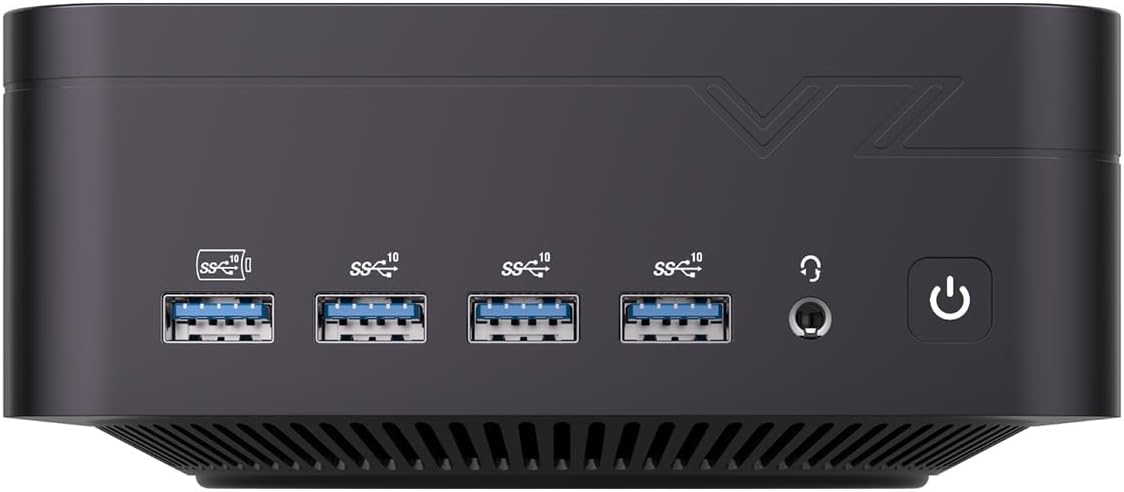
The VZMORE Mini PC iX9 Max is built for users who need sustained performance in a compact form. Vapor‑chamber cooling spreads heat 40% more than dual heat pipes, while V‑Boost Pro offers 20W silent, 40W normal, and 65W performance modes. The Intel Core Ultra 9 185H and AI Boost NPU handle demanding multitasking, content creation, and AI workloads.
The Mini PC iX9 Max supports up to four displays through two HDMI 2.0 and two USB4 Type‑C ports, providing 40Gbps data transfer and up to 15W power delivery. Six USB‑A ports and an SD 4.0 card reader simplify peripheral connections. Two PCIe 4.0 x4 slots allow up to 5TB of SSD storage, and the 135 × 131.8 × 57.7mm chassis fits behind a monitor via VESA mounting.
Connectivity includes dual 2.5Gbps Ethernet, Wi‑Fi 7, and Bluetooth 5.4 for wired and wireless peripherals. Windows 11 Pro is preinstalled, giving a familiar environment for productivity and development. The aluminum‑alloy chassis and V‑Guard validation assure long‑term reliability, while ESD/EMC protection guards against interference. A 3‑year limited warranty and local support are included.

Pros
- Play Modern Games Smoothly With Radeon 760M iGPU
- Run Multiple Apps Simultaneously With 32GB DDR5 RAM
- Connect Three 4K Displays Via USB4 HDMI
- Transfer Data Quickly With 2.5G LAN
- Upgrade Storage Easily With PCIe 4.0 Slots
Cons
- No Dedicated Graphics Card Beyond iGPU
Expand details⌄
Detailed Review
The GMKtec M6 Ultra Mini PC is built around the AMD Ryzen 5 7640HS APU, delivering a 30% performance boost over earlier Ryzen 7 models while staying within a 45W‑60W TDP envelope. Coupled with 32GB of DDR5 memory and a fast 1TB PCIe 3.0 SSD, the system handles demanding workloads and multitasking without slowing down, making it a compact yet powerful alternative to larger desktop rigs.
Graphics are handled by the Radeon 760M iGPU, which can play moderate titles at steady frame rates and supports hardware encoding for AV1, HEVC, and AVC codecs. Network connectivity includes a dual 2.5G RJ45 port for lag‑free wired links, WiFi 6 for fast wireless, and Bluetooth 5.2 for peripherals, while USB 4.0, HDMI 2.0, and DisplayPort enable the system’s hallmark triple‑4K display capability.
The design also offers upgrade paths: DDR5 slots accept up to 128GB total, and the dual M.2 slots allow a PCIe 4.0 drive up to 8TB. A 3‑year warranty and responsive after‑sales support give confidence, while the compact form factor makes it suitable as a server office PC or a sleek gaming workstation.

Pros
- Multitask Smoothly With 16GB DDR4
- View FourK On Three Screens With HDMI USB
- Transfer Files Over 2 point 5 Gbps LAN
Cons
- Compact Form Limits Upgrade Options
- No Built In Camera For Video Calls
Expand details⌄
Detailed Review
The GMKtec Mini PC i7-1185G7 stands out with its 11th‑gen Intel Core i7‑185G7 running at 4.8 GHz, delivering desktop‑class speed while consuming only 35 W of power. This efficiency makes the unit suitable for continuous work without heavy power draw, outperforming older i7 models such as the 10810U and 8259U in everyday tasks. Its 4‑core, 8‑thread design and 12 MB cache further accelerate multitasking, making it a solid choice for professionals who need sustained performance.
Memory and storage are generous, with 16 GB DDR4 SODIMM fitted and room to expand to 64 GB, ensuring future‑proofing for demanding applications. The 1 TB NVMe PCIe 3.0 drive provides fast boot times and ample space, and both M.2 2280 and 2242 slots allow additional storage up to 2 TB, giving flexibility for growing data needs. The dual‑channel configuration maximizes bandwidth, supporting graphics rendering and virtualization without bottleneck.
Display options are robust, with Intel Iris Xe Graphics G7 handling demanding visuals and three independent 4K outputs via two HDMI and a USB‑C port, ideal for workstation setups. Connectivity includes 2.5 Gbps Ethernet, Wi‑Fi 6 and Bluetooth 5.2, enabling fast file transfers over LAN. The included VESA mount and a three‑year warranty, with component replacement after the first year, add practicality for long‑term deployment.
How These Mini PCs Stack Up on Paper
The table shows a clear split between business-focused machines and performance-focused ones. The HP and GEEKOM lean toward steady office and shared-use work, with the GEEKOM stressing low power draw. The VZMORE and both GMKtec models push harder on processing and display support.
Memory and storage are where you can spot upgrade room at a glance. Several listings start at a modest amount, so check the expansion notes before you commit to a configuration.
| Product | Processor | Memory | Storage | Display Outputs | Power Draw |
|---|---|---|---|---|---|
| HP ProDesk 4 G1i | Core Ultra 5 235T | Up to 32GB DDR5 | 1TB PCIe M.2 SSD | HDMI, DisplayPort | — |
| GEEKOM A5 | Ryzen 7 7730U | 16GB DDR4, up to 96GB | 500GB PCIe SSD | — | 15W design |
| VZMORE iX9 Max | Core Ultra 9 185H | 24GB | 1TB SSD | Up to 4 displays | 20W, 40W, 65W modes |
| GMKtec M6 Ultra | Ryzen 5 7640HS | 32GB DDR5 | 1TB PCIe SSD | Up to 3 displays | 45W-60W TDP boost |
| GMKtec M2 Pro S | Core i7-1185G7 | 16GB DDR4 | 1TB NVMe SSD | Up to 3 displays | 35W |
What to Check Before You Buy a Compact Desktop
Mini PCs vary more than their size suggests, so a few specs will tell you most of what you need. Focus on the work you do every day before you look at anything else.
Match the Processor to Your Daily Work
The processor decides how smoothly multitasking feels, so it matters most when you run many apps at once. For email, documents, and video calls, a mid-range chip is plenty. If you edit video or run heavier software, look at the higher-core options.
Newer chips with dedicated AI engines can offload some tasks from the main processor. That helps only if the apps you use support those engines, so check before you pay extra for it. The HP ProDesk 4 G1i and VZMORE iX9 Max are the ones built around that idea.
If you mostly browse, stream, and handle office files, the GEEKOM A5 gives you solid everyday speed without overspending on cores you won’t use. Pick the processor based on your heaviest task, not your average day.
Plan Memory and Storage for Growth
Memory is the spec you’ll feel first when a machine slows down under load. Sixteen gigabytes handles light work, while thirty-two gigabytes gives you more breathing room for demanding tasks. Some models let you add more later, which can stretch the life of the PC.
Storage works the same way, and a one-terabyte drive is a comfortable starting point for most people. Check whether the chassis has room for a second drive or a larger SSD. Upgrade room matters more than the starting number if you plan to keep the machine for years.
The GEEKOM A5 is the clearest example of this, with memory and storage that can grow well past the starting configuration. If you want the most headroom from day one, the GMKtec M6 Ultra starts with generous memory.
Count Your Displays and Ports
Think about every monitor, dock, and peripheral you plan to connect before you choose. Some mini PCs support three displays, while others handle four. Mixing HDMI, DisplayPort, and USB-C outputs can get tricky, so confirm what your monitors accept.
USB-C ports are useful, but not every one carries video or power in the same way. Look at the port labels and the number of USB-A ports if you rely on older peripherals. A card reader or extra USB ports can save you from buying a hub.
The VZMORE iX9 Max stands out here with four displays and plenty of USB ports, which suits trading desks and data monitoring. The HP ProDesk 4 G1i is a better fit for a standard office with a couple of monitors and a wired network connection.
Think About Cooling, Noise, and Power Use
Small cases can get warm under sustained load, and that heat often shows up as fan noise. If the PC sits on your desk all day, quiet operation matters as much as raw speed. Power draw also adds up if the machine runs for eight or more hours daily.
Lower wattage usually means less heat and less fan noise, which helps in shared or quiet spaces. Some models offer power modes that let you trade speed for quiet. Higher wattage can help with sustained tasks like rendering or compiling code, but it runs hotter.
The GEEKOM A5 is designed for low power use and quiet operation, which makes it a sensible pick for a shared workspace. The VZMORE iX9 Max lets you choose between silent and performance modes, so you can adjust it to the job in front of you.
Which Mini PC to Pick for Your Setup
Your right pick depends on how many screens you run, how quiet your space needs to be, and whether you want room to grow. Start with the job you do most and choose the machine that fits that work without extra features you won’t touch. The three picks below cover the most common needs.
Office Workstation: HP ProDesk 4 G1i AI Mini PC Core: This one suits you if you want business-ready Windows, solid security, and enough ports to link a couple of monitors and wired peripherals. It’s a good match for a standard office or hybrid setup where reliability matters more than gaming or heavy rendering. If you need four or more displays or heavy creative work, pick the VZMORE iX9 Max instead.
Quiet Everyday Use: GEEKOM A5 Mini PC Ryzen 7 7730U: This is the one to choose if you run a shared space, a register, or a home desk that needs steady, quiet performance across long days. Its low power design keeps electricity and cooling demands modest, and the chassis is built to hold up in busy environments. If you need serious processing power or several high-resolution displays, look at the VZMORE iX9 Max or a GMKtec model.
Multi-Monitor Power: VZMORE Mini PC iX9 Max 24GB RAM 1TB: This suits you if you run trading screens, coding setups, or data dashboards and want four displays from a compact box. It also brings a large number of USB ports and an NPU for local AI tasks in compatible apps. If you want quiet operation on light tasks above all, the GEEKOM A5 is a calmer choice.
Questions Buyers Ask Before Ordering
How much memory do I really need in a mini PC?
For email, documents, video calls, and a handful of browser tabs, sixteen gigabytes is usually enough. If you run many apps at once or work with large files, thirty-two gigabytes gives you more breathing room. Check whether the memory can be upgraded later, since that can extend the life of the machine.
Can a mini PC really run three or four monitors?
Yes, but it depends on the model and the ports it offers. The VZMORE iX9 Max supports up to four displays through its HDMI and USB4 ports, while several GMKtec models support three. Confirm your monitors’ inputs and whether you need a dock before you buy.
Is a mini PC good for light gaming?
Some models handle light or older games at modest settings, but they aren’t built for demanding titles. Integrated graphics like those in the GMKtec and VZMORE models can manage casual play. If gaming is a main goal, you’ll get a better experience from a dedicated graphics card setup.
Do I need a special adapter or power supply for these PCs?
Most mini PCs use a standard external adapter included in the box, but some support power input through USB-C. The VZMORE iX9 Max is one example, where one USB4 port accepts power with a compatible adapter. Check the package contents and port details so you don’t end up short on cables.


